


Quick answer: The StrivePD Sleep Score is a daily 0-100 number, generated from your Apple Watch's overnight data, that tells you how last night compares to nights recorded by other people with Parkinson's - not to healthy adults. It's the first sleep score built from, and tested against, a Parkinson's disease population.
If you've ever looked at your watch in the morning and felt like it was grading you against a standard that doesn't apply to your life, you're not imagining it. Most sleep scores compare you to the general population. StrivePD compares you to people who are actually living what you're living.
Here's what the score is, how it was built, and what it can and can't tell you.
Sleep trouble isn't a side note in Parkinson's, it's close to universal. Research suggests as many as 9 in 10 people with Parkinson's experience some form of sleep disturbance over the course of the disease [1]. One study of 681 patients found 65.8% reported sleep problems, compared with 33.5% of people without Parkinson's — roughly double [2].
That disturbance isn't just "trouble sleeping" in a general sense. It can include:
The sleep that does happen looks different, too. Sleep efficiency (the percentage of time in bed actually spent asleep) averages 84.6% in older adults generally, but drops to 75.3% in early-stage Parkinson's and 67.1% in late-stage Parkinson's [5, 6]. These factors compound one another: Parkinson's can disrupt the brain regions involved in sleep, while stiffness and tremor can make it difficult to get comfortable or turn over. Medication may also wear off overnight, and anxiety or depression can further disrupt sleep [3, 7].
Why this matters for a sleep score: if a score is calibrated to healthy adults, nearly every night with Parkinson's looks like a failure, which isn't accurate, and doesn't give you anything useful to act on. StrivePD changes the comparison group so the number actually means something for your situation.
Each morning, the Sleep Score reads what your Apple Watch recorded overnight and compares that night to others recorded by people with Parkinson's. The output is a single number from 0 to 100 — a higher number represents more effective sleep.
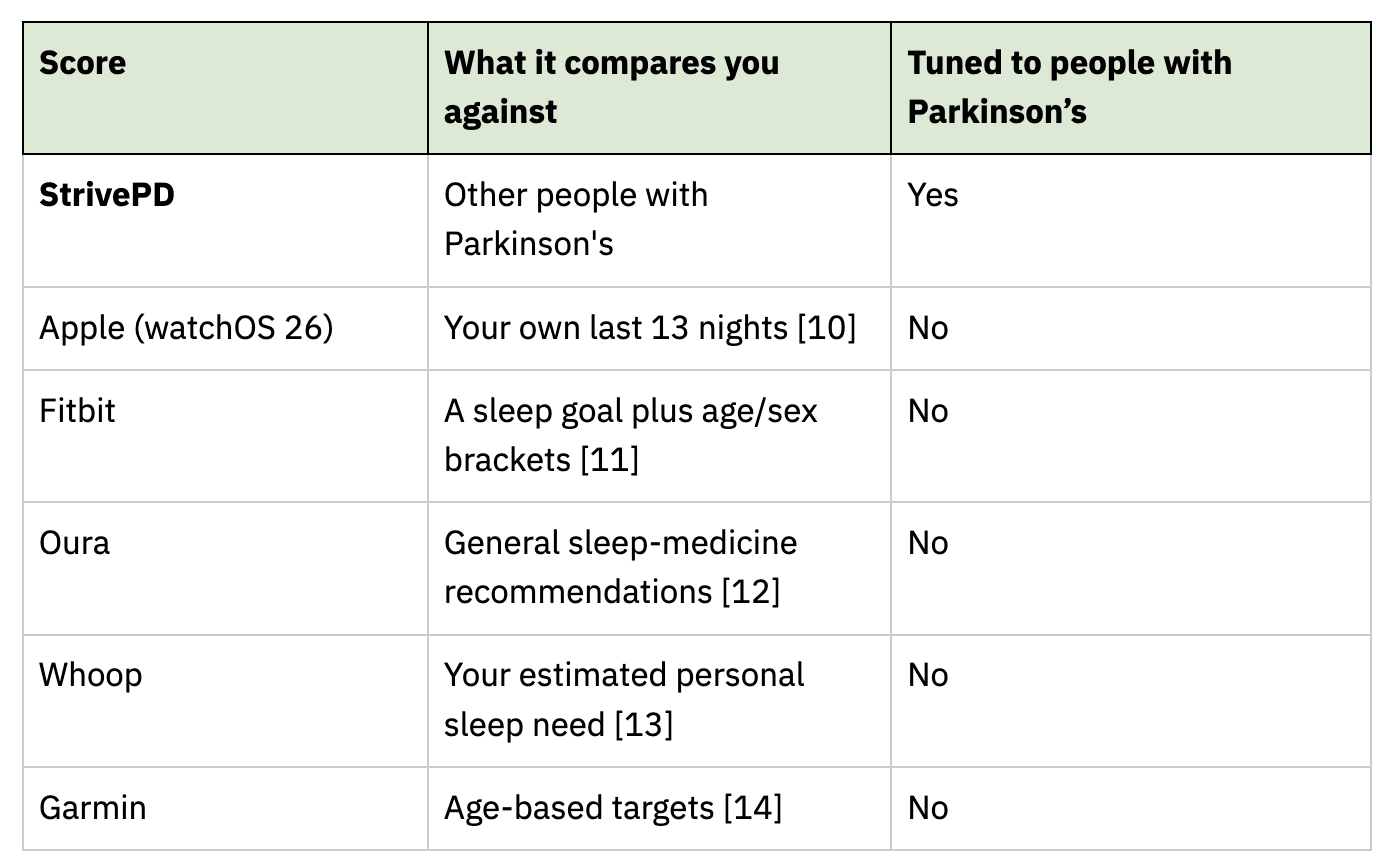
Every other major sleep score on the market compares you to yourself or to the general population. As far as we're aware, StrivePD is the first sleep score calibrated specifically to disease population.
The Sleep Score also uses the sleep measures recommended by the Digital Medicine Society (DiMe) through its DATAcc program - an FDA collaborative community - following DiMe's framework for evaluating health-tracking technology [8, 9].
One detail that matters: patients rate their own sleep before seeing what the watch recorded, on the same morning, which keeps the score from coloring the answer and keeps memory out of it.
No. The Sleep Score is not an FDA-cleared feature. It's built using sleep measures recommended by DiMe's DATAcc program, an FDA collaborative community, but the score itself has not gone through FDA clearance [8, 9].
No. The Sleep Score is a general measure of how your night compares to other people with Parkinson's - it does not diagnose, detect, or treat any specific sleep condition. If you're concerned about a specific sleep disorder, talk with your neurologist or a sleep specialist.
Those scores compare your night to your own recent history or to general population norms. StrivePD compares your night to a large group of other people with Parkinson's, and it's been tested against how actual Parkinson's patients rated their own sleep [10-14].
An Apple Watch that tracks sleep, paired with the StrivePD app, and a self-reported Parkinson's diagnosis in your profile.
No - scores are relative to the Parkinson's reference group, and that group shifts as more people join StrivePD. It's more useful to watch your own trend over time than to chase a specific number.
Sleep in Parkinson's is different - structurally, and in how it feels night to night - and a score built for the general population was never going to capture that well. The StrivePD Sleep Score was built from and tested against real Parkinson's patients, which is why it can answer a more useful question than "how did you sleep?" It can answer: how did last night compare to other nights, for someone in your situation?
That's not a diagnosis, and it's not a finish line. It's a number you can watch trend over time, alongside the rest of what StrivePD tracks - a small piece of turning your Apple Watch into a tool that actually understands Parkinson's.

